How to Watch Live Football Online: Streaming Guide 2026/27
Quick Answer: How to Watch Live Football Online
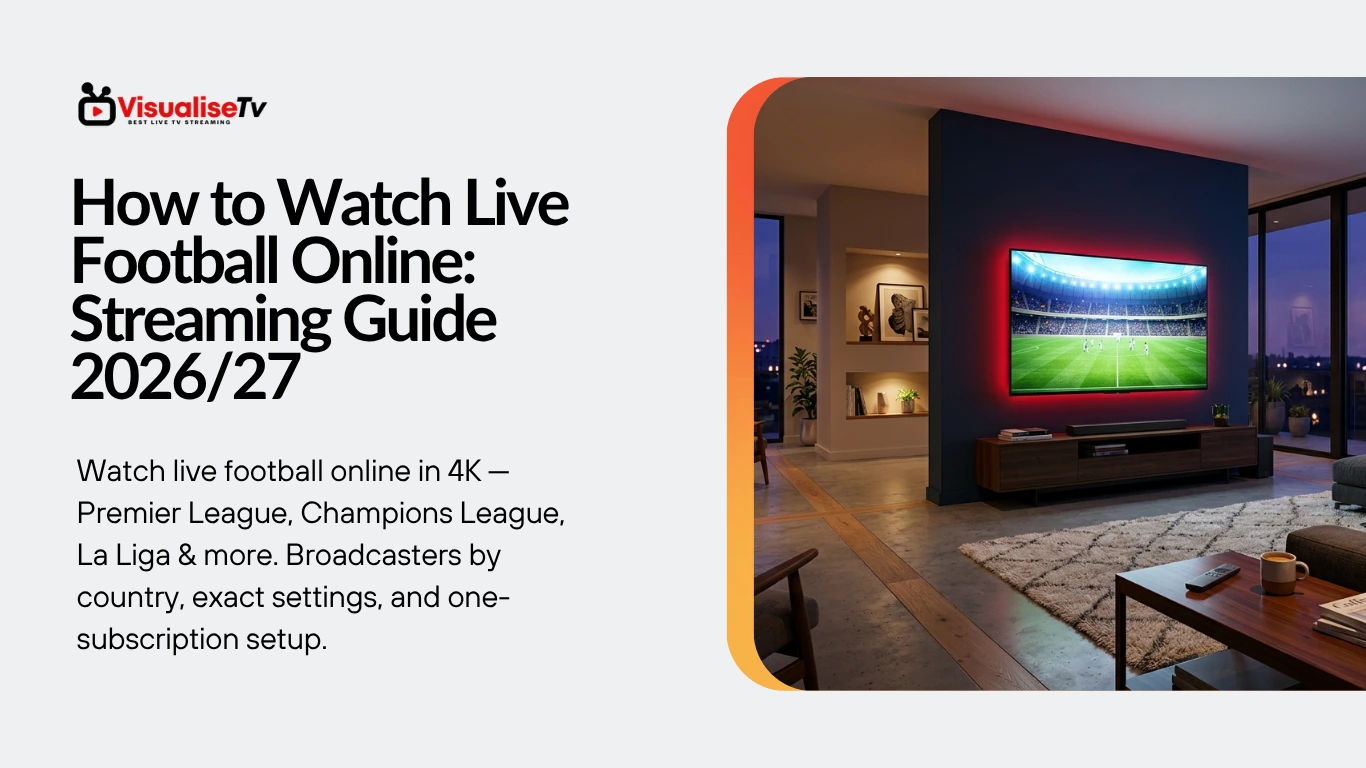
To watch live football online in 2026/27, you have three routes: official regional broadcasters (Sky Sports and TNT Sports in the UK, NBC/Peacock in the USA, DAZN in Canada), league platforms for single competitions, or a consolidated live TV subscription like VisualiseTv that carries football channels from dozens of countries — Premier League, Champions League, La Liga, Serie A, and Bundesliga — in one package, in 4K, on any device. The new season kicks off in August; the setup below takes fifteen minutes.
The 2026/27 football season is about to begin, and the way fans watch it has permanently changed. This summer’s World Cup — 104 matches across the USA, Canada, and Mexico, ending with Argentina lifting the trophy in the era’s final chapter at MetLife Stadium — was watched online by more people than any sporting event in history. Millions of those viewers discovered something during the tournament: streaming live football has become easier, cheaper, and higher quality than the cable arrangements they grew up with.
This guide carries that knowledge into the new season. It covers every legitimate way to watch live football online — by country, by competition, by device — with the exact technical setup that delivers stadium-quality 4K streams without buffering through a full nine-month season.
Table of Contents
- The 2026/27 Season: What Kicks Off When
- The Three Ways to Watch Football Online
- Official Broadcasters by Country
- Watching Every League With One Subscription
- Best Devices for Football Streaming
- The 4K Setup: Exact Settings for Match Day
- Fixing Stream Delay and Buffering
- What It Costs: The Real Comparison
- Frequently Asked Questions
The 2026/27 Season: What Kicks Off When
The football calendar barely pauses. Weeks after the World Cup final, the club season returns across every major league. Mark these windows:
- Premier League: Mid-August 2026 — 380 matches through May 2027
- La Liga: Mid-August 2026 — Barcelona and Real Madrid’s post-World Cup campaigns
- Serie A and Bundesliga: Late August 2026
- Champions League: League phase from September 2026 — the expanded 36-team format
- Europa League and Conference League: September 2026 onwards
- AFCON qualifiers, World Cup 2030 qualifying, and international breaks scattered through the season
For fans who follow more than one competition — which after this World Cup summer is more fans than ever — the question is not whether to stream, but how to do it without stacking four subscriptions.
The Three Ways to Watch Football Online
Every legitimate option falls into one of three categories, each with a distinct cost and coverage profile.
Route 1: Official Regional Broadcasters
The traditional route: subscribe to the broadcaster holding rights in your country. Quality is excellent, and coverage of your domestic league is complete. The limitation is fragmentation — no single broadcaster carries everything, so following multiple leagues means multiple subscriptions, and travelling abroad usually breaks your access entirely.
Route 2: League and Platform Streaming Services
Individual platforms — Peacock for Premier League in the USA, DAZN in various markets, league-owned apps — sell direct access to specific competitions. Flexible and contract-free, but the per-competition cost stacks up fast for multi-league fans.
Route 3: Consolidated Live TV Streaming
A single subscription carrying sports channels from dozens of countries — meaning every major league’s broadcast feeds in one place. This is the route that grew the fastest during the World Cup because it solves the fragmentation problem at a fraction of the cost of stacked subscriptions. Services like VisualiseTv carry 35,000+ live channels including the international sports networks broadcasting Premier League, Champions League, La Liga, Serie A, Bundesliga, and every major tournament — in 4K, without regional blackouts, on any device.
Official Broadcasters by Country (2026/27 Season)
United Kingdom
- Sky Sports: The majority of Premier League matches, EFL, and more
- TNT Sports: Champions League, Europa League, and selected Premier League fixtures
- BBC: Match of the Day highlights, FA Cup selected matches free-to-air
- Amazon Prime Video: Selected Premier League rounds
United States
- NBC and Peacock: Premier League — full coverage split between broadcast and streaming
- Paramount+: Champions League, Serie A
- ESPN+: La Liga, Bundesliga, FA Cup
- FOX: Continuing major tournament coverage after its World Cup summer
Canada
- Fubo Canada: Premier League rights
- DAZN: Champions League, Europa League
- TSN and CTV: Selected international coverage
Middle East and North Africa
- beIN Sports: Exclusive rights to nearly every major competition — Premier League, La Liga, Champions League, Serie A — via subscription and the beIN Connect app
Notice the pattern: a fan in any single country who wants the Premier League, the Champions League, and one foreign league needs two to four separate subscriptions from this list — every month, for nine months.
Watching Every League With One Subscription
This fragmentation is exactly what consolidated live TV streaming solves, and why it became the fastest-growing way to watch football during the World Cup summer.
Because a service like VisualiseTv carries broadcast channels from dozens of countries rather than one region’s rights packages, a single subscription includes the sports networks showing every major competition: the UK feeds, the US feeds, the European and Middle Eastern feeds, side by side in one channel list. The practical result for a football fan:
- Every Premier League match — including fixtures split across different regional broadcasters
- Full Champions League coverage in the expanded 36-team format
- La Liga, Serie A, Bundesliga, Ligue 1 without separate subscriptions
- International tournaments and qualifiers as they arrive through the season
- 4K, FHD, and HD feeds with commentary options in multiple languages
- No regional blackouts — the match is on regardless of where you sit
The subscription works on Firestick, Samsung and LG Smart TVs, Android TV, iPhone, iPad, and PC — and a 24-hour free trial lets you verify the channel list and stream quality on your own screen before the season starts, without entering card details.
Best Devices for Football Streaming

- Amazon Firestick 4K Max: The best value for match streaming — Wi-Fi 6, hardware 4K decoding, and full player app support
- Samsung and LG 4K Smart TVs (2020+): Native apps, superior motion handling for fast play — disable motion smoothing (see below)
- Apple TV 4K: The premium option — flawless 4K HDR and AirPlay from iPhone
- NVIDIA Shield / Android TV box: The power user’s choice for multi-league viewing with TiviMate
- iPhone and iPad: Match-day viewing anywhere — hardware decoding keeps 4K smooth without draining the battery
The 4K Setup: Exact Settings for Match Day
A football stream has different requirements from a film: motion clarity matters more, and latency matters most. These settings are tuned for live matches specifically.
- Internet: Verify 50 Mbps on the streaming device itself — not your phone. Marginal? A $12 Ethernet adapter ends the conversation. Test here!
- Decoder: Hardware (HW+) in your player settings — software decoding drops frames exactly when play speeds up
- Buffer: 2000-3000 ms for live matches — low enough to stay near-live, high enough to absorb network turbulence
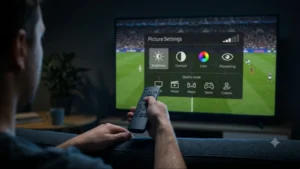
- TV motion smoothing: OFF — Auto Motion Plus (Samsung), TruMotion (LG), Motionflow (Sony) make football look artificial and add processing delay.
- Picture mode: Standard or Movie — never Vivid, which crushes shadow detail in evening matches
- EPG update: Refresh the morning of match day so kickoff times display correctly
Fixing Stream Delay and Buffering
Two problems ruin live football streams, and both are fixable.
The stream lags live.
- Lower the player buffer to 2000 ms — every extra second of buffer is a second behind the stadium.
- Use Ethernet — wired connections cut both delay and its variability.
- A well-configured stream runs 15-30 seconds behind live; poorly configured setups run a minute or more — the difference between hearing the neighbours celebrate before you see the goal, or not.
The stream buffers during big matches
- If it happens at peak kickoff times specifically, the provider’s servers are the cause — switch to a service running load-balanced multi-region infrastructure.
- If it happens at all times, work through connection, decoder, and cache fixes on your device first.
- Full diagnosis: see our complete guide to fixing IPTV buffering
What It Costs: The Real Comparison
The stacked-subscription route for a multi-league fan in 2026/27 — domestic league service, Champions League platform, one foreign league — lands between $60 and $95 per month depending on country, or roughly $540-850 across a nine-month season. Cable-based sports packages run higher still.
A consolidated live TV subscription covering all of the above costs $5-15 per month — $45-135 for the entire season — with the film and series library included on top. For households that discovered streaming during the World Cup and are now facing subscription decisions for the new season, that comparison is the entire decision.
The sensible move before the season starts: run a free trial during a live match evening, flip through the sports channels you will actually use, and judge the 4K quality on your own screen. VisualiseTv’s 24-hour trial exists for exactly this test — and August’s opening fixtures are the perfect proving ground.
Frequently Asked Questions
How can I watch live football online?
Three routes: official regional broadcasters (Sky Sports and TNT Sports in the UK, NBC/Peacock in the USA, DAZN in Canada, beIN in MENA), individual league platforms, or a consolidated live TV subscription like VisualiseTv that carries football channels from dozens of countries — every major league in one package, in 4K, on any device.
What internet speed do I need to stream live football?
A stable 25 Mbps minimum for Full HD and 50 Mbps for 4K, measured on the streaming device itself. Stability beats peak speed — a consistent 30 Mbps outperforms a fluctuating 100 Mbps line. For live matches, a buffer of 2000-3000 ms keeps you close to the live action.
Can I watch the Premier League without cable?
Yes. Peacock streams Premier League in the USA without cable; Sky Stream offers contract-free options in the UK. A consolidated subscription like VisualiseTV includes Premier League coverage alongside every other major league, with no cable requirement, on Firestick, Smart TV, phone, and PC.
What is the cheapest way to watch all football leagues?
Stacking official services for multiple leagues costs $60-95 monthly. A consolidated live TV subscription carrying international sports channels costs $5-15 monthly and covers every major competition in one package — the most economical route for multi-league fans by a wide margin.
How can I watch football in 4K?
You need a 4K device (Firestick 4K, Samsung/LG 4K Smart TV, Apple TV 4K), a 50 Mbps connection, and a service carrying 4K sports feeds. Enable the Hardware (HW+) decoder in your player and switch off motion smoothing on the TV for the clearest match picture.
Why does my football stream lag behind live TV?
Buffer size is the main cause. Lower the player buffer to 2000 ms for live sports, connect via Ethernet, and enable hardware decoding. A well-configured stream runs 15-30 seconds behind the stadium rather than a minute or more.
Be Ready Before the Season Kicks Off
Premier League, Champions League, La Liga, Serie A, and every major competition — one subscription, 4K quality, any device. Test it free for 24 hours before August kickoff.